_edited.png)

Why Do Unrelated Animals Look Like Cats? (Convergent Evolution for Kids)
- Nib
- Jun 21
- 2 min read
Updated: Aug 13
👨👩👧 MISSION INFORMATION (FOR GROWN-UPS)
🎯 RECOMMENDED: Age 8–12 years
⏱️ READING TIME: 2 minutes
🔬 STEM FOCUS: Biology • Evolution • Animal Classification
🧠 BRAIN SKILLS: Pattern Recognition • Observation • Critical Thinking • Scientific Classification
🎁 INCLUDES: Printable Case File
❓TODAY'S BIG QUESTION: Why do so many different animals look like cats—even when they aren’t related?
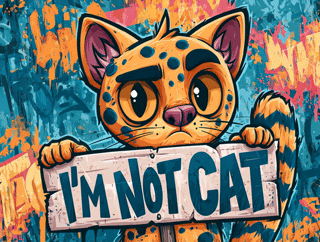
There’s an animal on Earth called a fossa that looks EXACTLY like a cat crossed with a weasel crossed with a tiny puma… and it is not a cat. AT ALL. 😱

I nearly fell out of my ship.
I’ve been cataloguing animals that look like cats, and I keep making the SAME mistake. Pointy ears.
Sneaky eyes.
Soft paws.
A long swishy tail.
My brain goes “CAT DETECTED. LOG IT AS CAT.” 🐱
Then someone tells me “Nope. Not a cat. Not even close.”
This has happened SEVEN times now. I am starting to take it personally.
So what is going on down here??
The Mystery Has a Name 🔍
Convergent evolution is when two totally different animals evolve similar features because they’re solving the same survival problem — even though they’re not related at all.

Weird, right? Once you know it, you start seeing it everywhere.
Here’s the deal: some animals need to sneak up on small prey, move fast without being seen, and hunt in low light. Animals that get good at this tend to survive and have more babies — so over time, more and more of them end up with the traits that looks liika cats:
• Quiet paws for silent stalking
• Bendy bodies for quick pounces
• Forward-facing eyes for judging distance
• Long tails for balance
Different animals. Same job to do. Similar “cat-shaped” result. 🐆
Nature isn’t copying and pasting. It’s more like two chefs in different kitchens who’ve never met, both inventing pizza, because pizza is just a really good idea. 🍕

Meanwhile, Spot Found Something!
While I was writing this very seriously, Spot found a photo of quoll in my Australia archive and started shrieking.

Pointy face. Whiskers. Spotted coat. Hunts at night. Humans down there literally nickname it the “native cat.”
“CAT! IT’S LITERALLY CALLED A CAT!” Spot was vibrating so hard I thought he’d short-circuit.
Except a quoll is NOT a cat. Quolls are marsupials — animals that carry their babies in a pouch, like kangaroos. Cats don’t do that. Not even a little. Spot found the “not-cattiest cat” on the entire planet by accident. 🐾
Nib’s Final Note 🛸
Earth isn’t full of copy-pasted cats. It’s full of different animals that separately solved the same problem — and landed on a similar answer.
That’s way cooler than if they were all just… cats.
🔎 YOUR CHALLENGE
Find an animal that looks like it belongs to one animal family, but doesn’t. What job do you think it evolved to do? Spot will be very, very excited regardless of what you find.



References & Learn More:
LiceScience—What Is Convergent Evolution?
Kiddle—Convergent evolution facts for kids
KidzSearch / Wiki—Convergent evolution Facts for Kids
Simple English Wikipedia—Convergent evolution
Biology Dictionary—Convergent Evolution—Definition and Examples
Mental Floss—Close-But-Not-Quite Cats
https://www.mentalfloss.com/animals/8-close-not-quite-cats?utm
Comments