_edited.png)

Desert Plants vs. Ocean Plants: Why They Solve the Same Problems
- Nib

- Dec 16, 2025
- 3 min read
Updated: Aug 13
👨👩👧 MISSION INFORMATION (FO👨👩👧 MISSION INFORMATION (FOR GR GROWN-UPS)
🎯 RECOMMENDED: Age 8–12 years
⏱️ READING TIME: 3 minutes
🔬 STEM FOCUS: Biology • Ecology • Plant Science
🧠 BRAIN SKILLS: Pattern Recognition • Comparing & Contrasting • Systems Thinking • Scientific Curiosity
🎁 INCLUDES: Printable Case File
❓TODAY'S BIG QUESTION: Why do desert plants and ocean plants solve the same survival problems even though they live in completely different places?
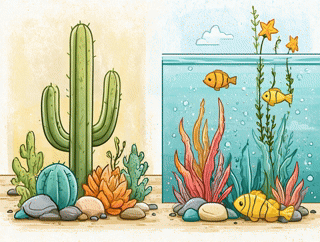
A giant cactus called a saguaro can store up to 200 gallons of water inside its own body. That’s like carrying two full bathtubs around with you, forever, just in case. 😳
When I landed on Earth, I figured desert plants and ocean plants had NOTHING in common. One’s baking hot and bone-dry. The other is soaking wet and surrounded by more water than it could ever need.
Opposite problems. Obviously opposite solutions.
I was completely wrong. Earth is doing that thing again. 🤨
Problem #1: “The Thing I Need Keeps Getting Away!”
Desert plants are chasing water. It might not rain for months, and when it finally does, the water vanishes almost instantly. So cacti, plural for cactus, and succulents turned themselves into living water tanks:
• Thick stems and leaves for storing water
• Roots that grab rain fast, before it’s gone
• Waxy skin to stop water from escaping
They’re not chunky because it looks cool. They’re carrying emergency water bottles. 🧴
Ocean plants have the opposite resource problem — there’s water everywhere, but sunlight is scarce, especially once you go deep. So kelp and seaweed do the one thing that gets them closer to it: they grow UP, straight toward the surface, some of them fast enough to build entire underwater forests.
Different treasure. Same chase. 🏁
Problem #2: “Don’t Let Anyone Take It!”
Once you’ve got the thing you need, you have to protect it — and desert and ocean plants protect themselves in almost opposite ways, for the same reason.
Cacti go stiff and armored: sharp spines, thick skin, barely any leaves to lose water through. Kelp, for example. goes the total opposite direction — long, bendy, flexible, so waves and currents don’t snap it in half. Instead of fighting the water, it just moves with it.
Sometimes the smartest way to survive is to go rigid. Sometimes it’s to dance. 🕺
Meanwhile, Spot Found Something
While I was writing this very seriously, Spot decided to “help” by digging around the base of my cactus. He grabbed a root, yanked — and got a spine straight in the paw. 🌵💥
“OW! WHY IS THE PLANT ATTACKING ME?!”
It’s not attacking you, Spot. It’s protecting its water. Same reason you don’t share your snacks.
He is now standing three feet away from the cactus, deeply offended, still holding the root.
Nib’s Final Observation 🛸
I thought a desert and an ocean were complete opposites. Instead, they’re basically asking the same two questions: how do I get the thing I need, and how do I keep it?
Different worlds. Different plants. Nearly identical strategy.
This is called convergent evolution — when very different living things land on very similar solutions, because they’re solving the same survival problem. Nature isn’t running out of ideas. It’s just reusing the good ones. 🔁
🔎 YOUR CHALLENGE: Find a plant — outside, in a photo, anywhere. Ask yourself: what problem is it solving? Water? Sunlight? Wind? Getting eaten? Every weird leaf or spike is probably the answer to something. Become a plant detective. 🕵️
Want me to save this as a file, or tweak Spot’s moment first?



References & Learn More:
Stanislaus State—Desert Plants: Storing and Protecting WaterDWesert Plants: Storing https://www.csustan.edu/biology/stan-state-greenhouse/desert-plants-storing-and-protecting-water?utm
National Library of Medicine—Physiology, genomics, and evolutionary aspects of desert plants
Scribd—Xerophytes and Hydrophytes
https://www.scribd.com/presentation/522768563/XEROPHYTES-AND-HYDROPHYTES?utm
Save My Exams—The Adaptations of Xerophytic & Hydrophytic Plants (

Comments